Learn · Field and check-in
The daily check-in: days left, not percent complete
After this subject you can run a morning check-in, answer every row the schedule put in front of you, and read what your answers did to the forecast.
Two ways to say how far along you are
There are two honest answers to "how far along is the slab", and they are not equally useful to a schedule. One is a percentage. The other is the number of working days still to go. A percentage is a summary of the past; days left is a statement about the future, and a forecast is built out of the future.
Why it matters — a percentage summarises what has happened; a forecast needs a number about what is left.
The number the field already has
A super already knows how many working days are left on the pour. That is the number Brikt asks for. Percent complete is still there, and it is still what you show an owner — derived from days left rather than typed, in that direction and not the other.
10-day activity · 4 working days left → 60% complete · derived
Why it matters — it is the number they have already been thinking about since Monday.
The date the schedule is speaking from
Every schedule in Brikt states its facts as of a date, the way a bank balance does. Before that date is what happened; after it is still the plan. That date is why the check-in asks what the schedule expected today, rather than what the calendar on the wall says.
Why it matters — the two agree for as long as the schedule date is kept current. Read next: what is a data date?
One list, every morning
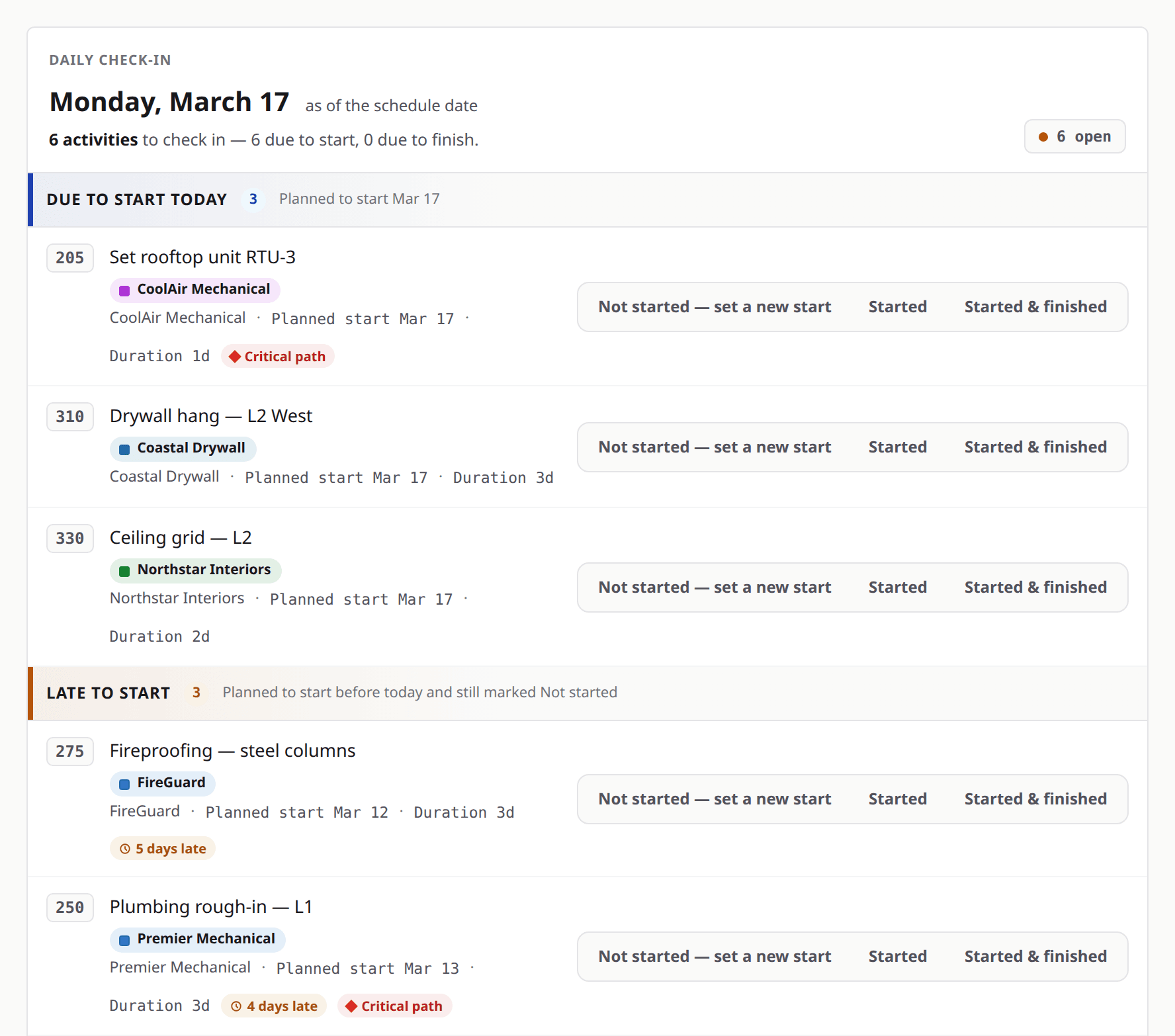
The check-in opens with the work the schedule expected to be underway. Rows sit in two bands — due to start on the schedule date, and late to start — and each row offers three plain answers: not started, started, or started and finished. A superintendent can get through it in under a minute, with no schedule training.
Look at
- 1The two start-side bands.
- 2The three answers offered before you touch a field.
- 3The count of what is still unanswered.
Why it matters — this list is the schedule date's list. Keeping that date current is what keeps “expected today” true.
And the work that should be finishing
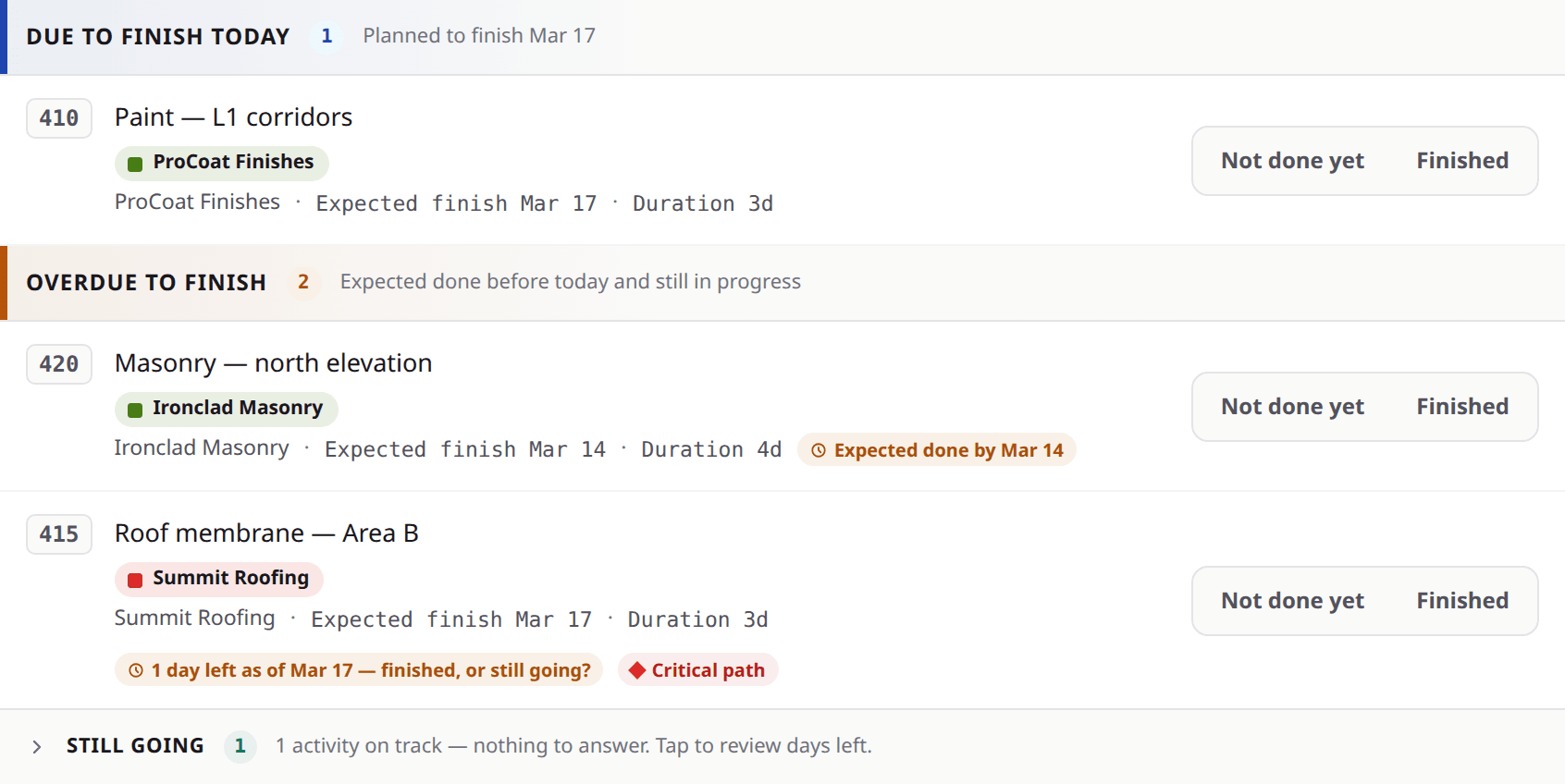
The morning question has a second half. Work already in progress is grouped by what the schedule expected of it — due to finish on the schedule date, overdue to finish, and still going — so the things quietly running long sit on the same screen as the things that never started.
Look at
- 1Due to finish on the schedule date.
- 2Overdue to finish — expected done before it, still in progress.
- 3Still going, collapsed: on track, nothing to answer.
Answering a row
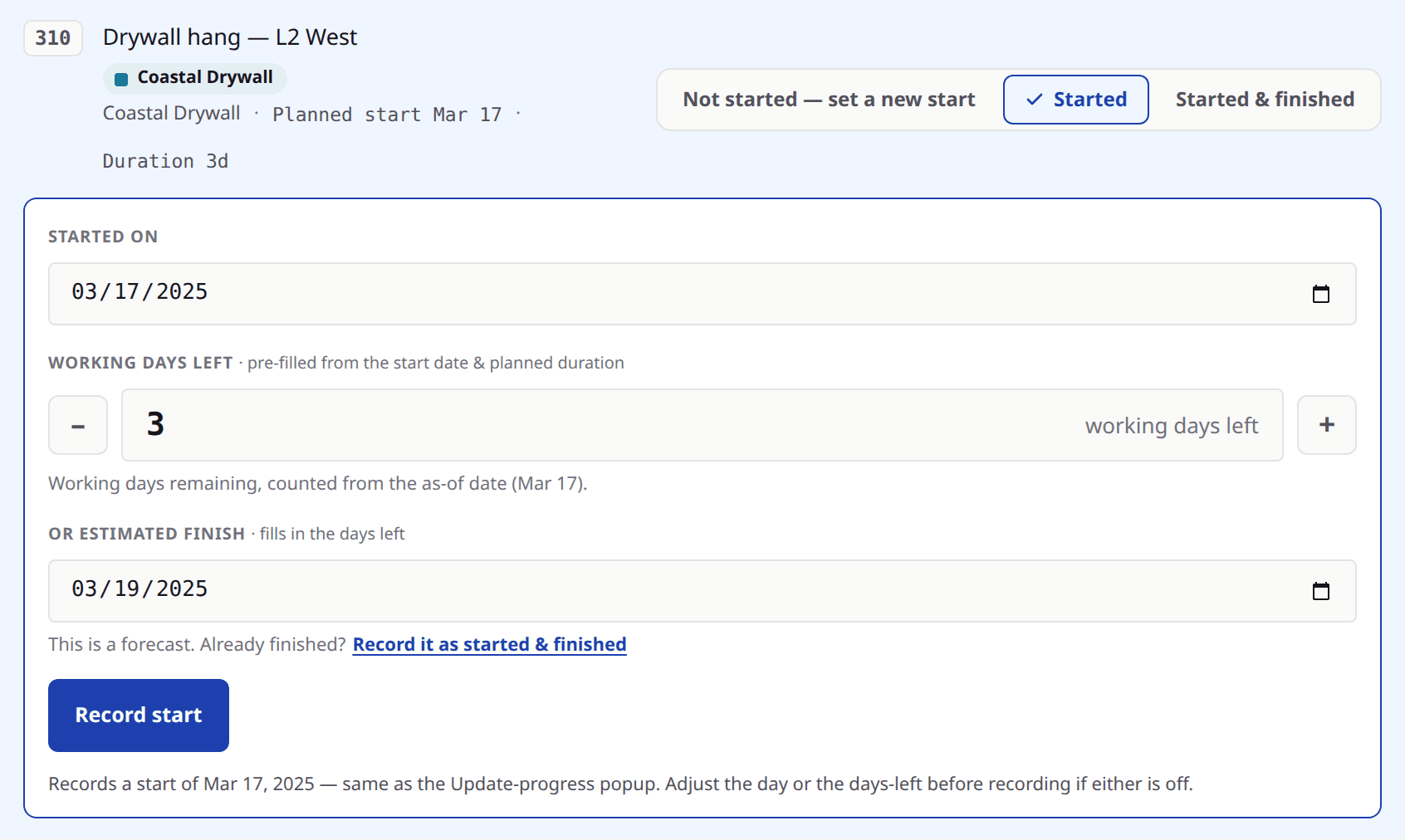
Every answer shows what it will record before it records it. Started asks for the start date and the working days left, and waits for you to confirm. Started and finished asks for both dates.
A confirmed answer is real progress recorded against the live schedule, so the forecast reflects it that morning rather than when somebody gets round to updating the file.
Look at
- 1The days-left field, pre-filled from the start date and the planned duration.
- 2Where it says the days are counted from — the as-of date, named.
- 3Record start: nothing is written before it.
Why it matters — “Not started” is an acknowledgement rather than a write, and there is no Save at the bottom to forget: each confirmed answer records on its own.
Miss a morning, keep the record
The days you skipped are carried forward for you to answer, rather than disappearing behind today's list. And a check-in interrupted by a delivery is a check-in half done, not a check-in lost — each answer you confirmed is already recorded.
When the answer is "it did not start"
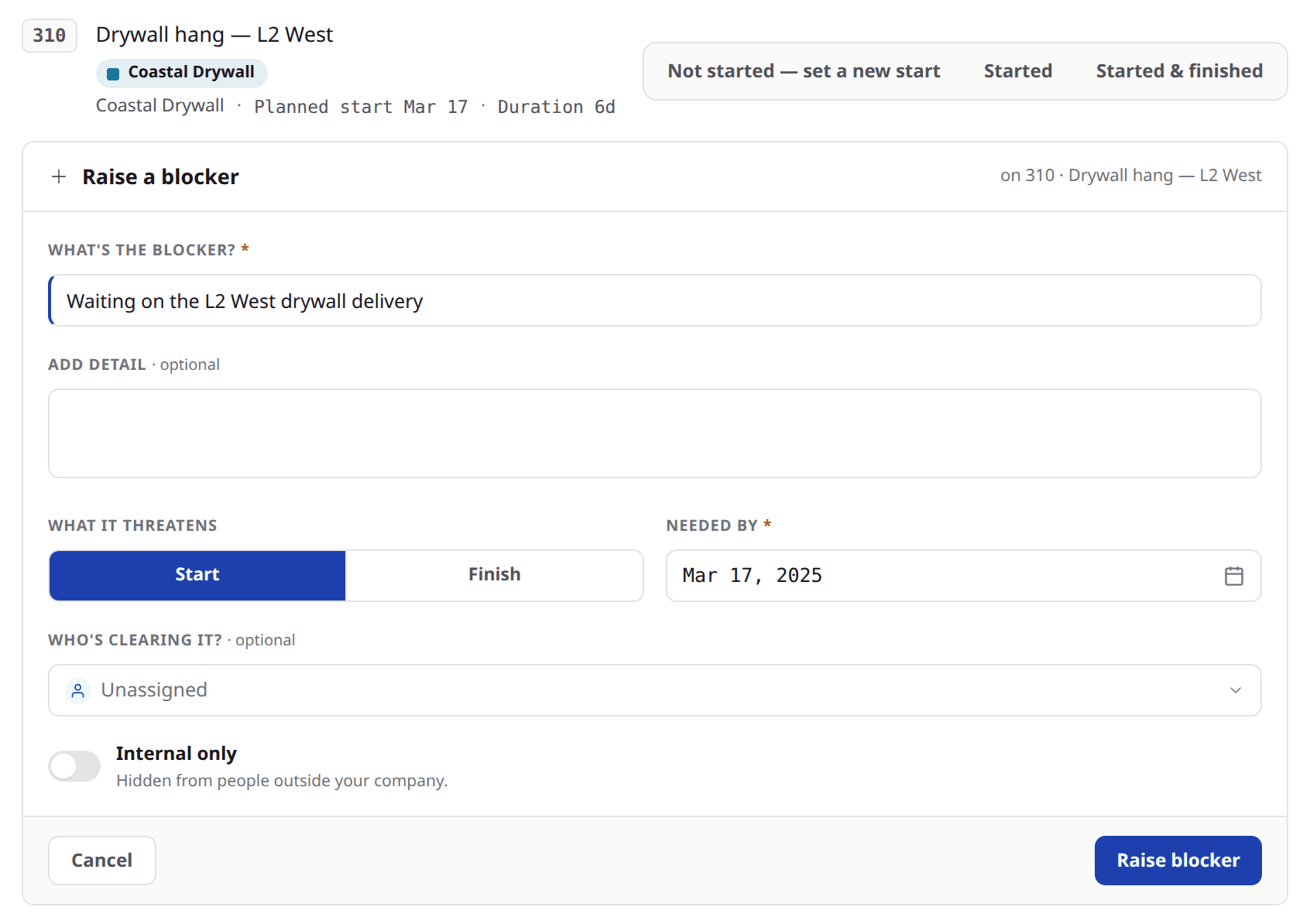
The moment the check-in tells you something did not start is the moment somebody knows why. So that is where you say it: the blocker is raised from the check-in itself, against the schedule date you were shown — validated, not trusted.
A blocker never moves a date on its own. It becomes a record: what is blocked, and when it is needed by.
Look at
- 1It opens on the row itself — the raise never leaves the list.
- 2The two required answers, starred: what it is, and when it is needed by.
- 3No category list. The sentence you would say out loud is the record.
Why it matters — if that date moves while you are writing, the raise is refused rather than saved against a date nobody was measuring from.
Ask for days, get a forecast
Ask
How many working days are left on the rough-in?
Instead of
What percent are you at?
Ask
Did the pour start this morning?
Instead of
Is concrete on track?
Ask
What is it waiting on, and when do you need it by?
Instead of
Why is this late?
What to remember
- The check-in asks what the schedule expected — on both the start side and the finish side.
- Progress is working days left, entered by the field and counted from the schedule date.
- Percent complete is derived from days left, in one direction only.
- Every answer confirms what it will record, and each confirmed answer records on its own — there is no Save at the bottom to forget.
- Missed mornings carry forward, and a blocker is raised where the lateness is realised.
Run one tomorrow morning
Open the check-in on a job you are running now and answer it once, start to finish. It runs in the browser on your phone — the same address, no app to install. If you would rather see it on your own schedule first, bring one to a demo and we will run it together.